Following the great success of the 1st European Circus History Conference in London in 2025, we are delighted to announce that the next edition of the biennial conference will take place in Denmark at the wonderful Copenhagen Circus Museum from Thursday 15th to Saturday 17th April 2027. Appropriately, that Saturday will coincide with World Circus Day.
The first day will allow participants to get to know one another as they are taken on a tour of important circus locations in the City that will include the world-famous Tivoli Gardens.
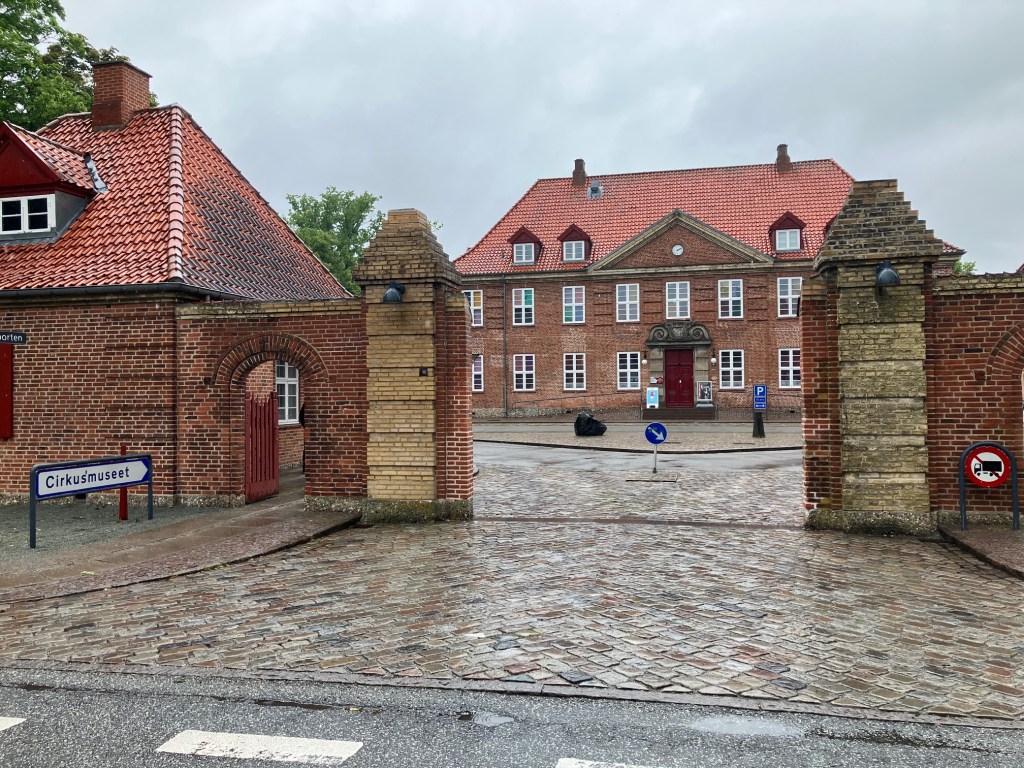
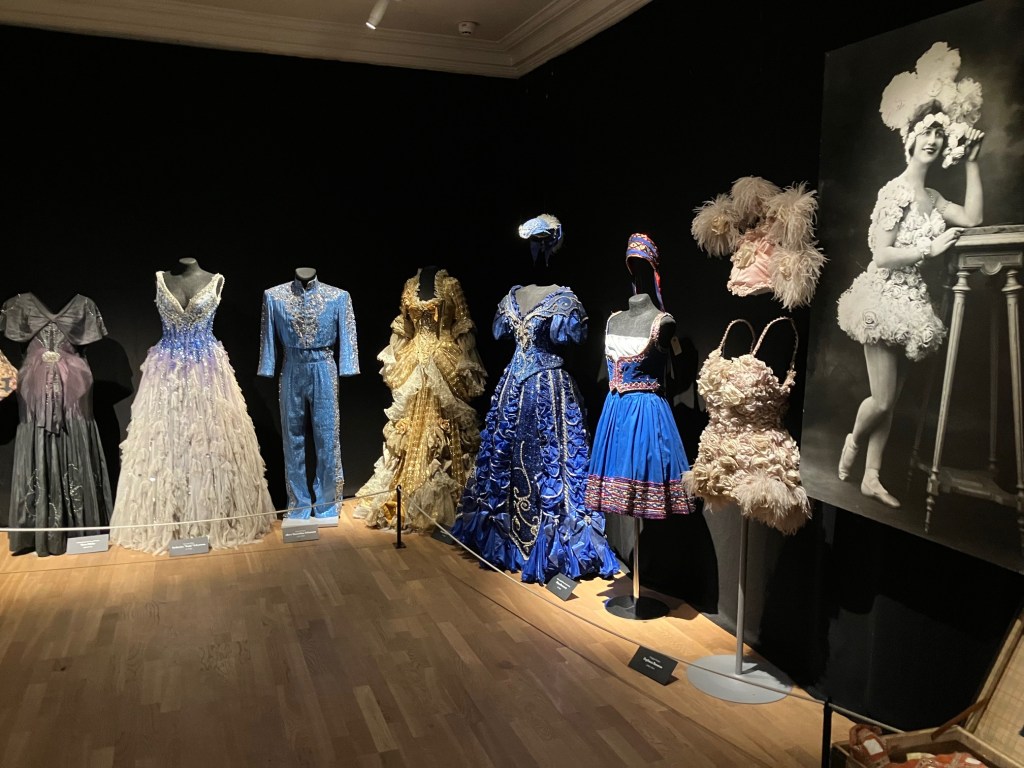
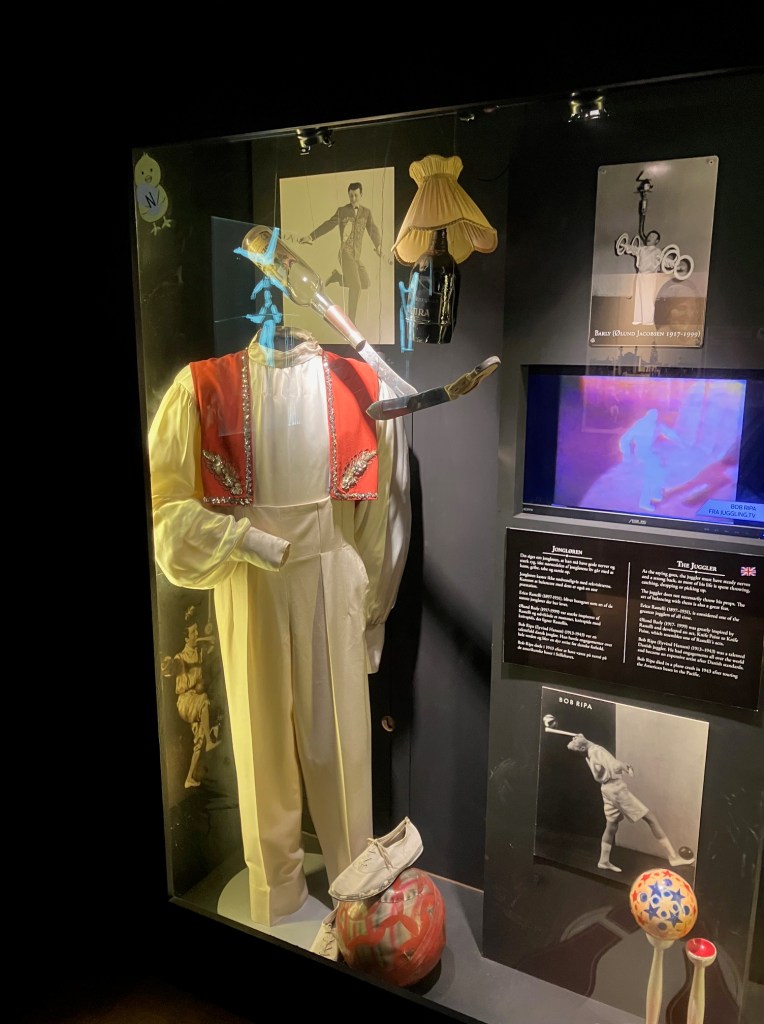
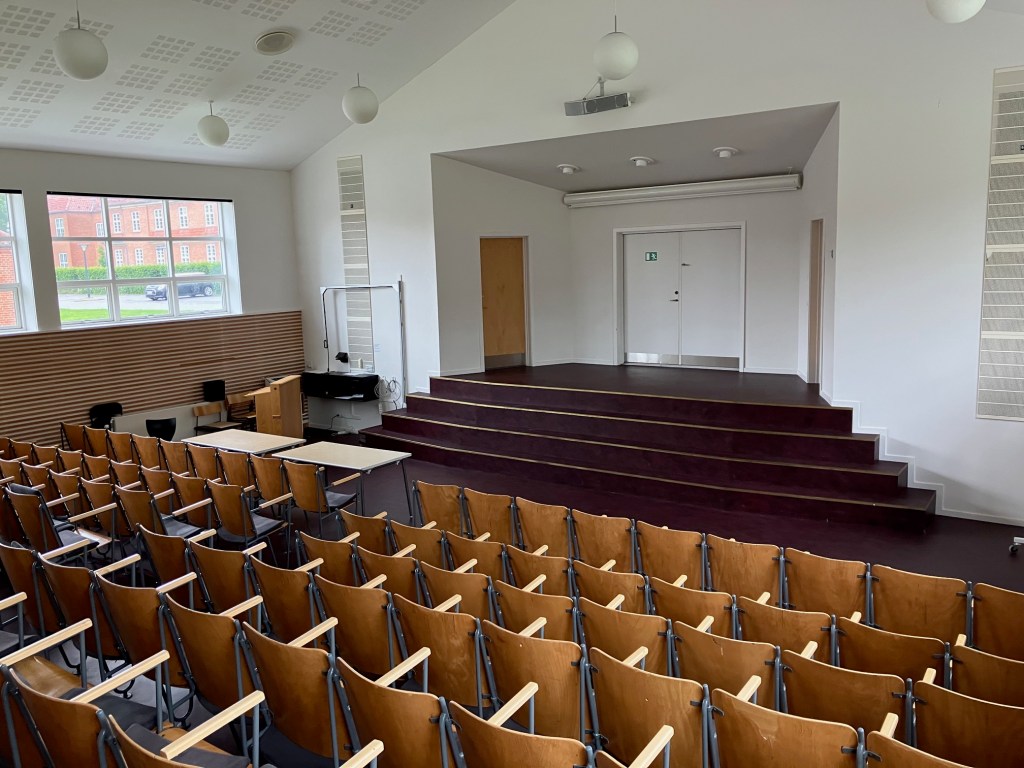
The conference will take place during the day on Friday and Saturday at the Circus Museum in Hvidovre, a suburb of Copenhagen, which has a 120 seat conference theatre on the site. See the photos below.
The central theme will be ‘How has circus related to change‘ which can encompass how circus has responded to change, initiated it or ignored it. Changes could be political, social, geographic etc. The focus is on change relating to Europe, though the change(s) can also be inwards or outwards of the continent. The call for papers will be made nearer the time.
The ECHC is enormously grateful to Mikkel Knudsen, the Museum Director, and his team for offering to host the 2nd conference.
The organising committee for this conference comprises:
Charlie Holland (UK), Initiator of the European Circus History Conference. A former professional juggler who was instrumental in the development of The Circus Space, latterly National Centre for Circus Arts, as its Programme Director and Deputy Chief Executive. His books include ‘Strange Feats and Clever Turns’ on speciality acts in the 19th century. He is the Secretary of the British Music Hall Society and initiated and co-organised their first conference in 2023 and subsequent ones. His latest project is the London Juggling and Flow Arts Festival, to take place in October 2026.
Pauliina Räsänen (Finland), a circus and magic artist and cultural historian (MA) from Finland is a graduate of the renowned National Circus School of Montreal. Her performance background includes touring with Cirque du Soleil’s Alegria as a solo trapeze artist for six years. She is currently pursuing her PhD in Cultural History at the University of Turku, researching the forgotten history of women in circus and magic, and is CEO of ArtTeatro Ltd, a Finland based circus and magic arts production company
Harm van der Laan (The Netherlands), an artist and co-artistic director of both Tall Tales Company and the Tall Tales Studio, which has grown to become the main space for training and ongoing education of the professional circus community in The Netherlands. Harm has BA and BSc degrees, teaches circus history at Codarts Rotterdam, and is co-author of the book ‘Turning the cube: Perspectives on codes through juggling and visual arts’.
Mikkel Knudsen (Denmark), Director of The Circus Museum in Hvidovre (a suburb of Copenhagen). Mikkel has a History MA and has worked at the museum since 2004. He has produced several exhibitions with topics including Circus Culture, the World of Magic, and Animals in the Circus. He has written many articles about circus and is often used as an expert by the media.
Kornélia Deres (Hungary), an associate professor at ELTE Eötvös Loránd University of Budapest, has published widely on theatre, performance, and cultural practices. She was the recipient of the Humboldt Fellowship at the University of Cologne, the Junior Core Fellowship at the Central European University, and the Bolyai Fellowship from the Hungarian Academy of Sciences. Her current research focuses on nineteenth-century popular performance culture and scientific spectacles in Central and Eastern Europe. She has authored two monographs and co-edited six volumes. She is also a poet and writer, having published four books.
Lina B. Frank (Sweden), a producer, programmer/curator and arts consultant based in Europe with offices in Lund/Malmö, SE and Bristol, UK.
Over seventy participants from at least sixteen different countries gathered in Lambeth, London, to discuss The Early Evolution of European Circus and its Disciplines, c1760s – 1860s, and the sun shone for all three days!
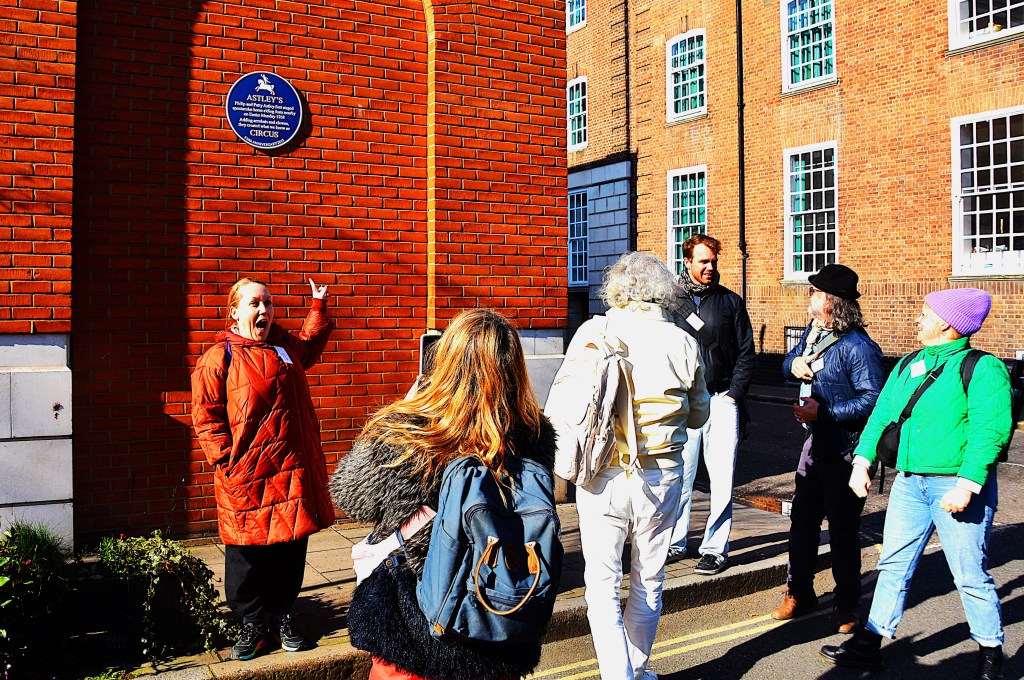
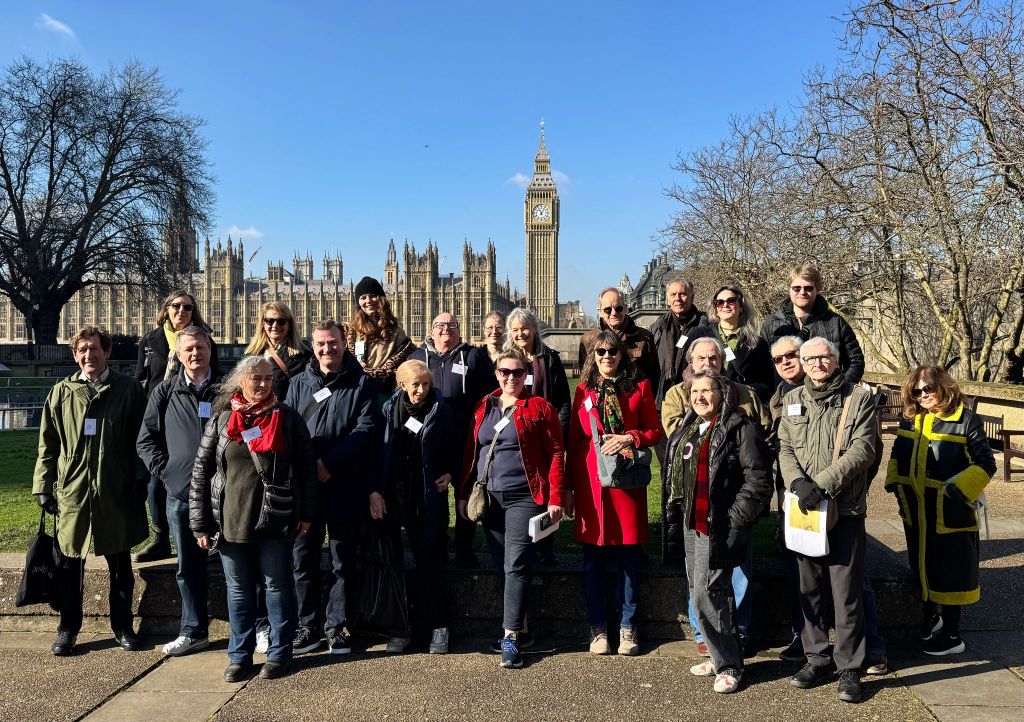
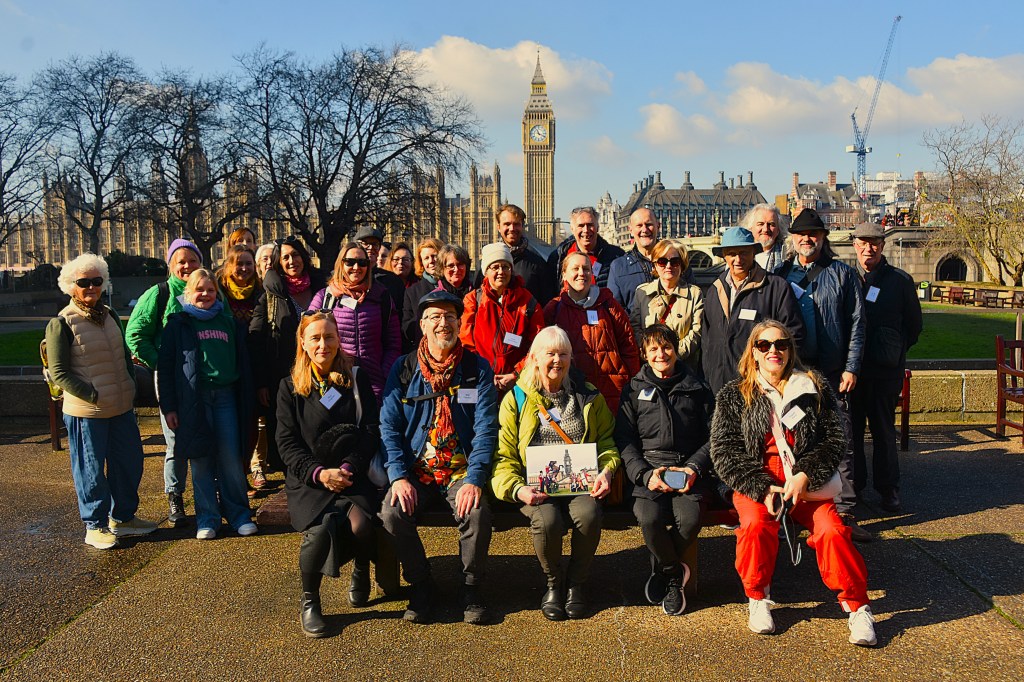
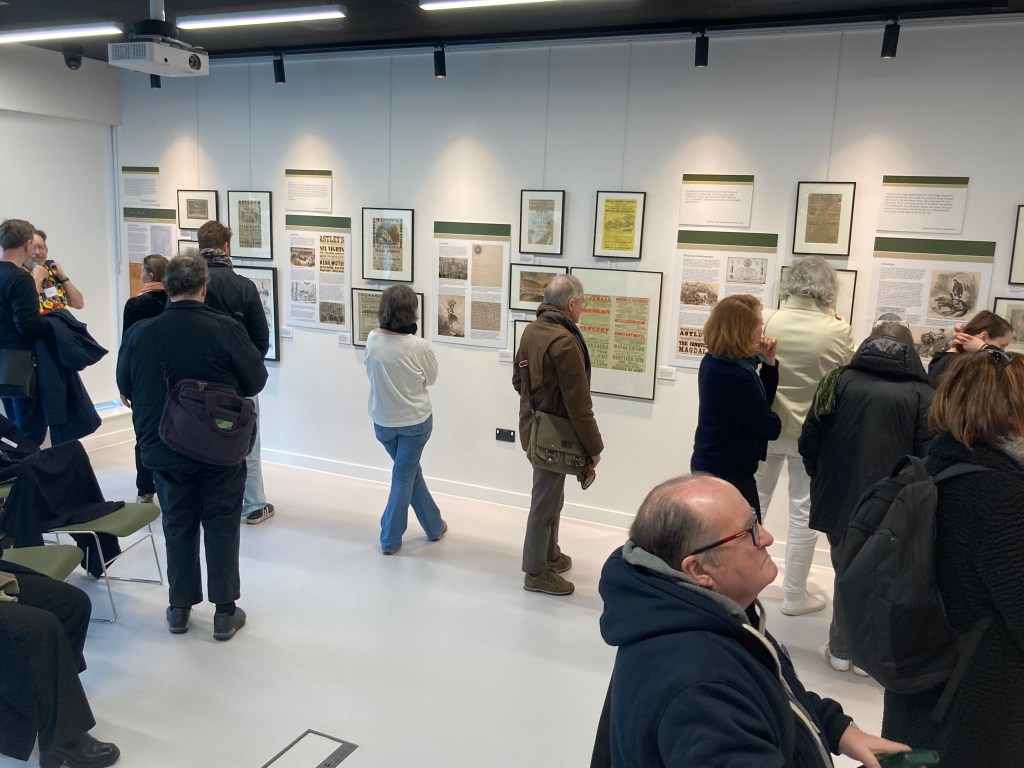
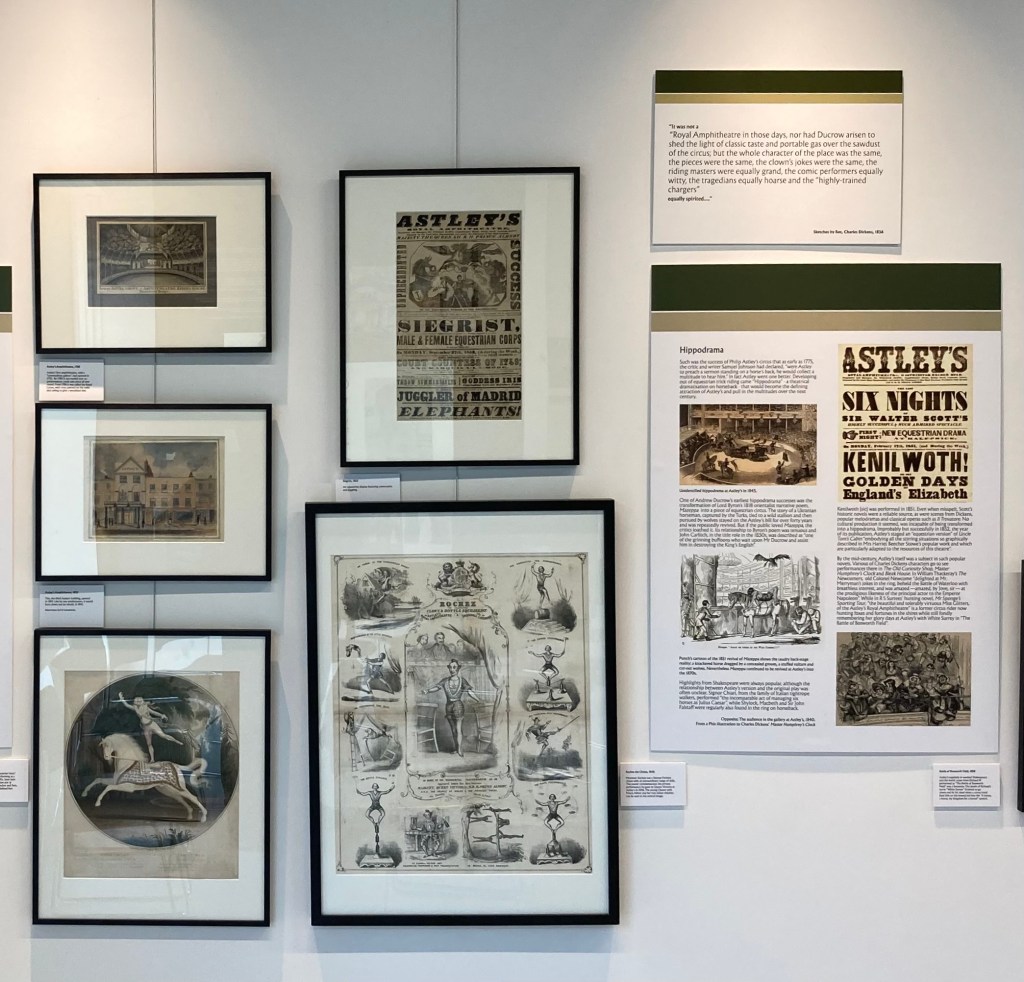
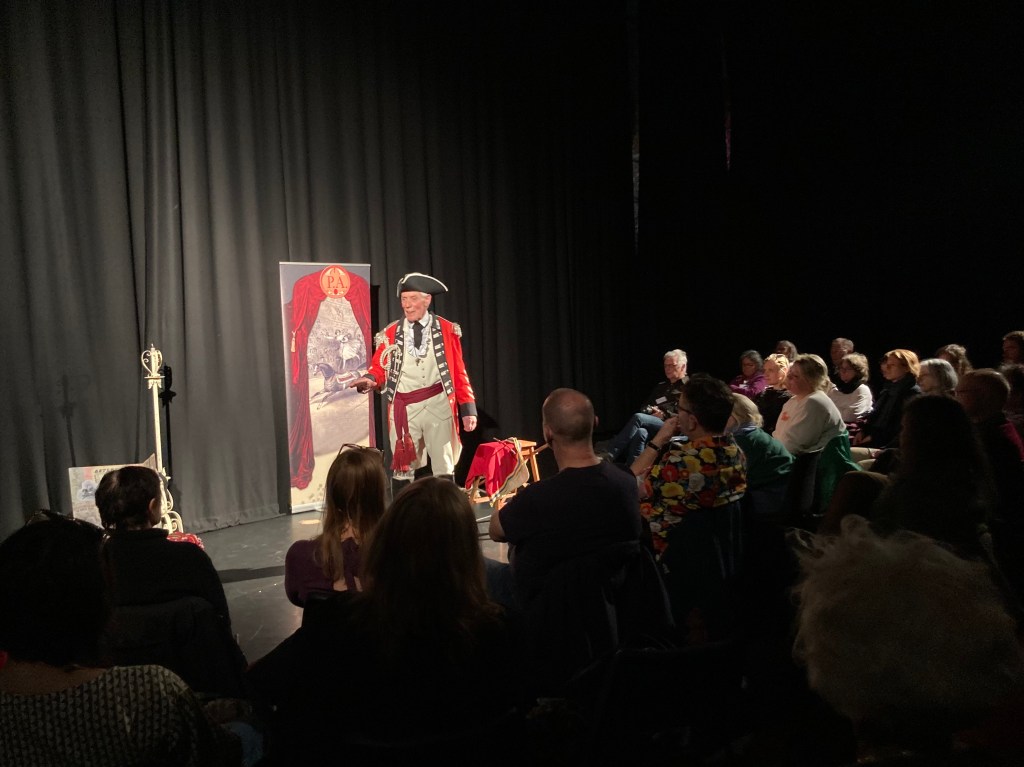
This was especially welcome on Friday which started with two Birth of the Circus led walks, followed by lunch in Brixton markets and a tour of the Ringside! exhibition (which runs to April 12th) at Lambeth Archives, and ended at the National Centre for Circus Arts for a tour and performance by Chris Barltrop of his one-man show Audacious Mr. Astley. Over the weekend there were seventeen 20-minute talks (see the previous post for topics) in the atmospheric Cinema Museum and, at the end of each day, discussion ran late into the night in a local pub.
The conference ended with thanks to all those who had contributed to the event, then a show of hands showed overwhelming support for future conferences on a biennial basis. Even better, institutions in Copenhagen, Verona and Amsterdam expressed interest in hosting them.
A few photos below give a taste of the event.
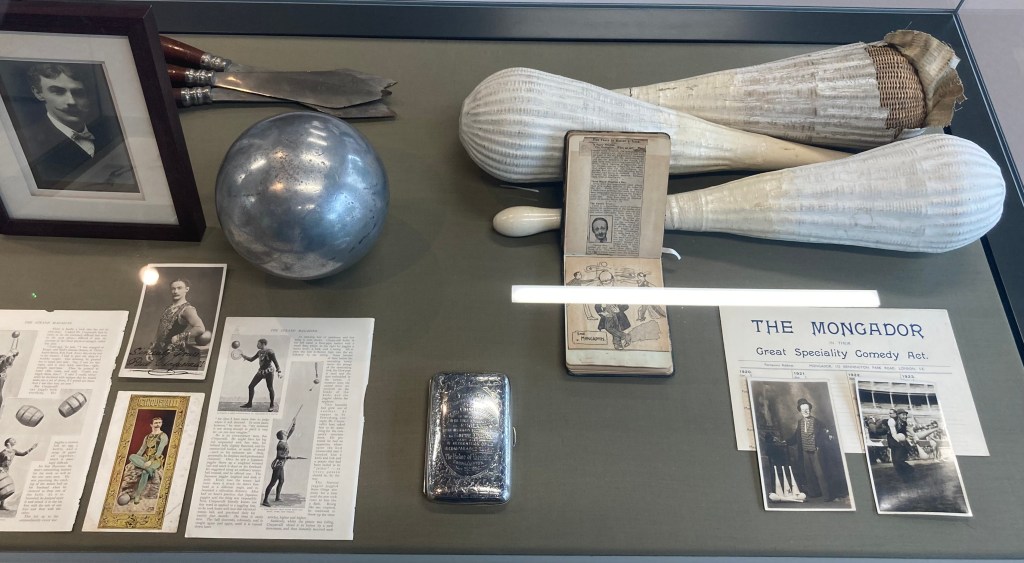
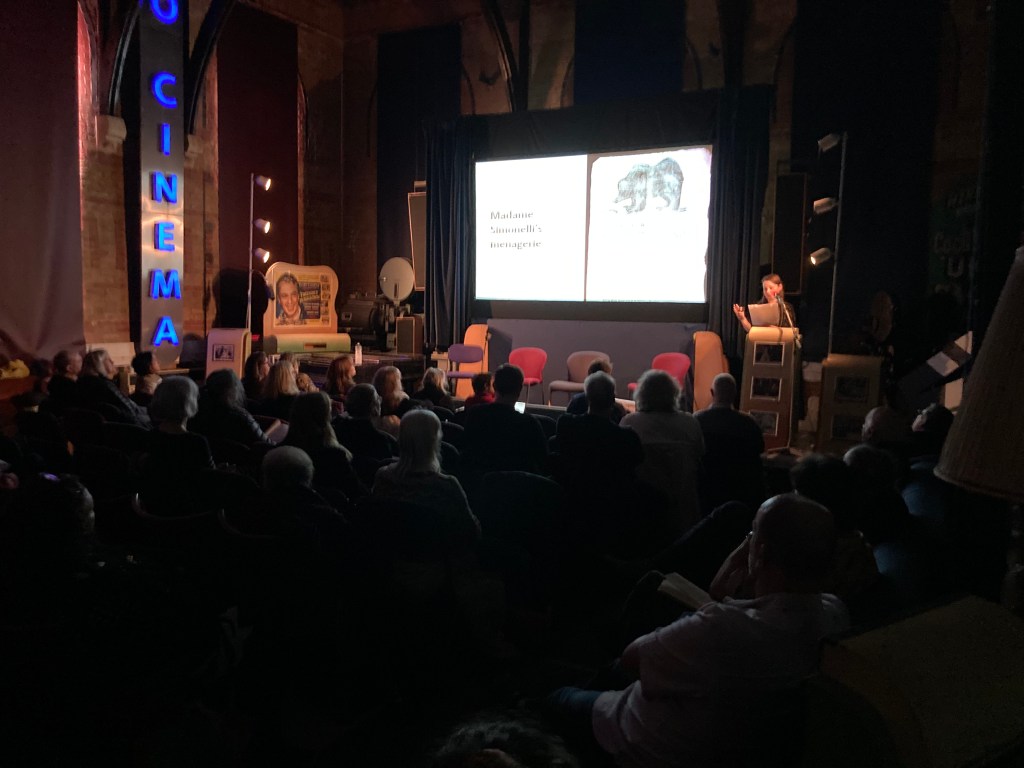
Participants on the first walk, led by Tracey Gregory, excited by the plaque nearby the former Halfpenny Hatch where Philip and Patty Astley first gave riding displays. Photo: Chris Everett.The first led walk group by the location of Astley’s Amphitheatre by Westminster Bridge, with the Houses of Parliament and Big Ben behind. Photo: Chris Everett. Below, the second led walk group, led by Charlie Holland, at the same location. Photo: Des FitzGerald.Lots of interest in the exhibition at Lambeth Archives which had detailed captions alongside original Astley’s posters and much more. This and following photos: Charlie HollandA display cabinet with antique props from artistes who lived in Lambeth including a cannon ball passed down to the juggler Jon Anton that is believed to have belonged to Cinquevalli. Chris Barltrop, as Mr. Astley, performing in the Creation Studio at the National Centre for the Circus Arts. Professor Kornélia Deres presenting Itinerant Female Performers and Menageries in Early Nineteenth-Century Budapest
The Early Evolution of European Circus and its Disciplines, c1760s – 1860s
London, Friday 28 Feb. – Sunday 2 Mar. 2025
Ticket purchase details are below the Schedule. Please email any queries to info@circusconference.org .
Philip Astley opened his riding school in Waterloo in 1768, shortly afterwards moving to the foot of Westminster Bridge, the site of his Amphitheatre. This volunteer-organised European Circus History Conference, hopefully the first of a biennial series held around Europe, focuses on developments in circus and its disciplines from around 1760 to the 1860s. Appropriately for a European event, the conference concerns circuses and performers active within any part of Europe, and also those who travelled into and from Europe.
Friday 28 February 2025, 10am – 6pm: Out and about in London and getting to know your fellow conference attendees.
10.15 – 12.15 (Meet from 10am outside the Waterloo Café at the junction of Sandell Street and Cornwall Road, SE1 8TG, two minutes from Waterloo tube and railway stations) A leisurely two-mile (3.5 km) Guided walk of the sites of Astley’s Riding School and Amphitheatre, and of Dibdin’s and Hughes’ Royal Circuspartly along the Thames
12.30 – 14.00 Lunch Break in Brixton’s historic arcades
14.00 – 15.15 Exhibition: Early Circus and Lambeth Circus Families, introduced by Lambeth Archivist Jon Newman at Lambeth Archives
16.15 – 17.00 Tour of National Centre for Circus Arts &Presentation on The National Fairground and Circus Archive by Senior Archivist Arantza Barrutia
17.00 – 18.00Audacious Mr Astley 45 minute performance by Chris Barltrop, Circus Ringmaster and Manager since the 1970s (limited to the first 40 to book for the conference due to space constraints)
Saturday 1st March, 10am – 5pm at The Cinema Museum, 2 Dugard Way (off Renfrew Road), London SE11 4TH – nearest tubes Kennington, Elephant & Castle.
10.00 – 10.30 Cinema Museum opens – tea and coffee, and bookstall
10.30 – 10.50 Introduction & The Mayor of Lambethopens the Conference
10.50 – 11.10 ‘My wife to conclude performs the rest’ – Patty Astley, the first lady of circus – Prof. Vanessa Toulmin, Professor and Director of City Culture and Public Engagement at the University of Sheffield, founder of the National Fairground and Circus Archive at the University of Sheffield, Chair of the Morecambe Winter Gardens Preservation Trust.
11.10 – 11.30 Just after the beginning: circus activity in Great Britain at the end of the eighteenth century – Dr Kim Baston, Associate Senior Lecturer (Theatre) at La Trobe University, Melbourne who for many years taught circus history and culture at NICA (National Institute of Circus Arts), Melbourne. Most recently, she has co-edited the essay collection Researching Popular Entertainment (2025, Routledge).
11.30 – 11.50 Q&A
11.50 – 12.00 Short Break
12.00 – 12.20 The first English horsemen in Italy – Dr Antonio Giarola, President of the National Association for the Development of Circus Arts (ANSAC) and of the Circus Arts Documentation Educational Center (CEDAC) in Verona. Italian poet, circus and theater director and circus historian, he also is the artistic director of The International Salieri Circus Festival.
12.20 – 12.40
12.40 – 13.00 Q&A
13.00 – 14.30 Lunch (1½ hours)
Panel: Mobilities of Early Circus in the Habsburg Empire
14.30 – 14.50 Itinerant Female Performers and Menageries in Early Nineteenth-Century Budapest – Prof. Kornélia Deres, Associate Professor at ELTE Eötvös Loránd University, Budapest. Her current research project focuses on 19th century performative knowledge transfer in Central and Eastern Europe. She is author of two books and co-editor of five academic collections. She is also a poet and writer, having published four volumes.
14.50 – 15.10 Mazeppa’s Transformations While Crossing Borders between the 1830s and the 1850s – Prof. Katalin Teller, Associate Professor at ELTE Eötvös Loránd University, Budapest. Co-curator of an exhibition on early show business in Pest-Buda (KiscellMuseum 2019-2022). Her second monograph, on the evolution of circus pantomimes with a historical theme, is forthcoming in Hungarian and German.
15.10 – 15.30On the Tracks of Itinerant Showpeople in the (Southern) Austrian Monarchy – Veronika Barnaš, an independent artist and curator studying for her PhD in Cultural Studies at the University of Art and Design Linz, researching itinerant showpeople, as well as work, entertainment, and technology (history) at temporary fairs.
15.30 – 15.50 Q&A
15.50 – 16.05 Tea break
16.05 – 16.25 The foundation years of circus in Australia, 1847-1856 – Dr Mark St Leon, Australia’s pre-eminent circus historian, author of ‘Circus: The Australian Story’ (Melbourne Books, 2011) and a direct descendant of Australia’s earliest family of entertainers.
16.25 – 16.45 “These Roaming Ministers of Pleasure” Euro-American circuses Touring in Asia, India and China 1859-1866 – Margaret Kirby is completing her PhD on this subject at Latrobe University in Melbourne. She has a family history in circus entrepreneurs, is a playwright, and performed and taught with Circus Oz and other companies.
16.45 – 17.05 Q&A
Sunday 2nd March, 10 – 5, at The Cinema Museum:
10.00 – 10.30 Cinema Museum open – tea and coffee, and bookstall
PANEL: Circus to America
10.30 – 10.50 Ricketts’ Journey to America, The transformation of English circuses into American Big Tops – Devin Jernigan, PhD student in Architectural History & Theory at Yale University researching The Architecture of the American Traveling Circus at the turn of the 20th-Century
10.50 – 11.00 European Circus and the San Francisco Gold Rush – Dr Doyle Ott, teacher at Sonoma State University and a healthcare clown with Medical Clown Project with a background in performing and directing circus alongside publishing circus research.
11.00 – 11.20 Staging Race in Early Transatlantic Circus – Prof. Leith Davis, professor in the Department of English and Director of the Centre for Scottish Studies at Simon Fraser University, Canada, and Principal Investigator “Early Circus” Digital Humanities project
11.20 – 11.40 Q&A
11.40 – 11.50 Comfort break
11.50 – 12.10 Achuen Amoy and the Chinese Magicians – Prof. Mary Chapman, Professor of English, University of British Columbia, Vancouver, Canada, with a book in progress on Amoy;Finding the Chinese Magicians – Eelyn Lee, award winning artist and filmmaker of Hong Kong-English heritage who has shown work at Barbican, Tate Modern, Whitechapel Gallery, National Portrait Gallery, Palais de Tokyo, and at international film festivals
12.10 – 12.30 Opulence and Ostentation; the age of the nineteenth century UK circus building – Dr Steve Ward, specialising in the cultural and social history of the circus and author of ‘By Royal Command, Barnum in Europe’ (MVP 2025) and eight other circus books.
12.30 – 12.50 Q&A; discussion
12.50 – 14.20 Lunch (1½ hours)
Panel: Northern Europe
14.20 – 14.40 The Development of the Circus through the Years 1799-1860 in Denmark – Mikkel Knudsen MA, Director of the Circus Museum in Hvidovre (Copenhagen)
14.40 – 15.00 The Role of Female Performers and Directors in the Early Stages of Circus in the Grand Duchy of Finland 1830s–1840s – Pauliina Räsänen, PhD candidate, University of Turku, Culture History; Graduate of National Circus School of Montreal and former trapeze artiste with Cirque du Soleil.
15.00 – 15.20 Q&A
15.20 – 15.35 Tea break
15.35 – 15.55 Sarah L’Africaine, the equestrienne who took Paris by storm – Susanna Forrest, independent researcher, author of The Age of the Horse: an equine journey through human history (Atlantic Books, 2016), currently working on a book about European circus equestriennes of the nineteenth century, Amazons of Paris.
15.55 – 16.20 The Gymnasium and the Evolution of Trapeze and related Aerial Disciplines in Circus, 1760s-1860s – Steve Gossard, author of ‘A reckless era of aerial performance : the evolution of trapeze’ (1994) and former curator of circus collections at Illinois State University’s Milner Library & Charlie Holland, former Programme Director at The Circus Space (now National Centre for Circus Arts) and author of Acrobats & Aerialists in Circus, Music Hall and Beyond, 1850s-1900s (MVP, forthcoming 2025)
16.20 – 16.40 Q&A
16.40- 17.00 Feedback and expressions of interest in hosting a future conference.
Tickets
Tickets for the whole event cost £55 (or £75 if you are able to support the conference with a donation to Astley poster restoration at Lambeth Archives), and can be bought here(The ticket site at NCCA requires registration as it is normally for circus classes so please disregard medical conditions etc. unless pertinent to a conference; also we will have a list of attenders so you do not need to collect tickets from the NCCA).
Please note that you will need to pay for local bus travel between events on Friday, that lunch is not included, that only the first 40 to book will receive a ticket to see Audacious Mr. Astley due to space constraints, and that the conference hall is on the first floor, up 20 steps (two flights of ten). Tickets are non-refundable though if the conference sells out we shall try to arrange a resale.
Circus to see in London during the Conference (not part of our programme): Corteo, Cirque du Soleil at the Royal Albert Hall; Footprint in the Snow by Laura Moy at Jackson’s Lane
Charlie Holland (UK), Initiator of the European Circus History Conference. A former professional juggler who was instrumental in the development of The Circus Space, latterly National Centre for Circus Arts, as its Programme Director and Deputy Chief Executive. His books include ‘Strange Feats and Clever Turns’ on speciality acts in the 19th century. He is the Secretary of the British Music Hall Society and initiated and co-organised their first conference in 2023 and subsequent ones.
Pauliina Räsänen (Finland), a circus and magic artist and cultural historian (MA) from Finland is a graduate of the renowned National Circus School of Montreal. Her performance background includes touring with Cirque du Soleil’s Alegria as a solo trapeze artist for six years. She is currently pursuing her PhD in Cultural History at the University of Turku, researching the forgotten history of women in circus and magic, and is CEO of ArtTeatro Ltd, a Finland based circus and magic arts production company
Erik Åberg (Sweden), an artist based in Stockholm who makes objects and performances, and has appeared in most European countries, Japan, Canada and the USA. He is.a PhD student in performative and media based practices at Stockholm University of the Arts where his research concerns circus, juggling, sculpture, history, archive and philosophy. An accomplished circus historian, Erik is the world’s foremost expert on the juggler Paul Cinquevalli, the subject of his newly published book ‘Cleverer than God’.
Harm van der Laan (The Netherlands), an artist and co-artistic director of both Tall Tales Company and the Tall Tales Studio, which has grown to become the main space for training and ongoing education of the professional circus community in The Netherlands. Harm teaches circus history at Codarts Rotterdam and is co-author of the book ‘Turning the cube: Perspectives on codes through juggling and visual arts’.
Raffaele de Ritis (Italy), writer and director, active in the USA and Europe, taking a modern theatrical approach to ancient spectacular traditions: circus, magic, cabaret. He wrote and directed for the world’s leading companies in the performing arts industry: Disney, Cirque du Soleil, Dragone, Ringling bros., Big Apple Circus, and Europe’s oldest theatres. His education crossed masters such as Federico Fellini and Dario Fo, art academies, century-old circus dynasties and the underworld of European variety. As a recognized historian in performing arts, he has authored seminal books and papers in seven languages, and teaches and lectures worldwide. Raffaele is custodian of an extensive private collection, and sits in the Performing Arts Council of Italy’s Ministry of Culture.
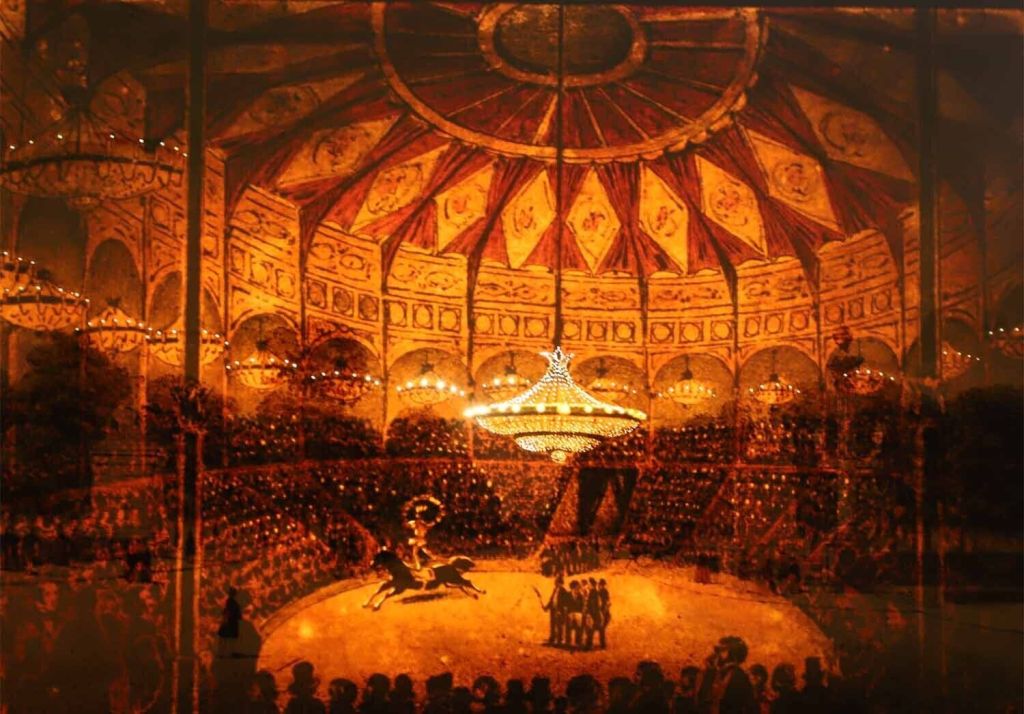
Polyorama Panoptique of the Cirque des Champs Elysées, circa 1850, courtesy of F. Binetruy
The Early Evolution of European Circus and its Disciplines, c1760s – 1860s
The Cinema Museum, London, 28 Feb. – 2 Mar. 2025
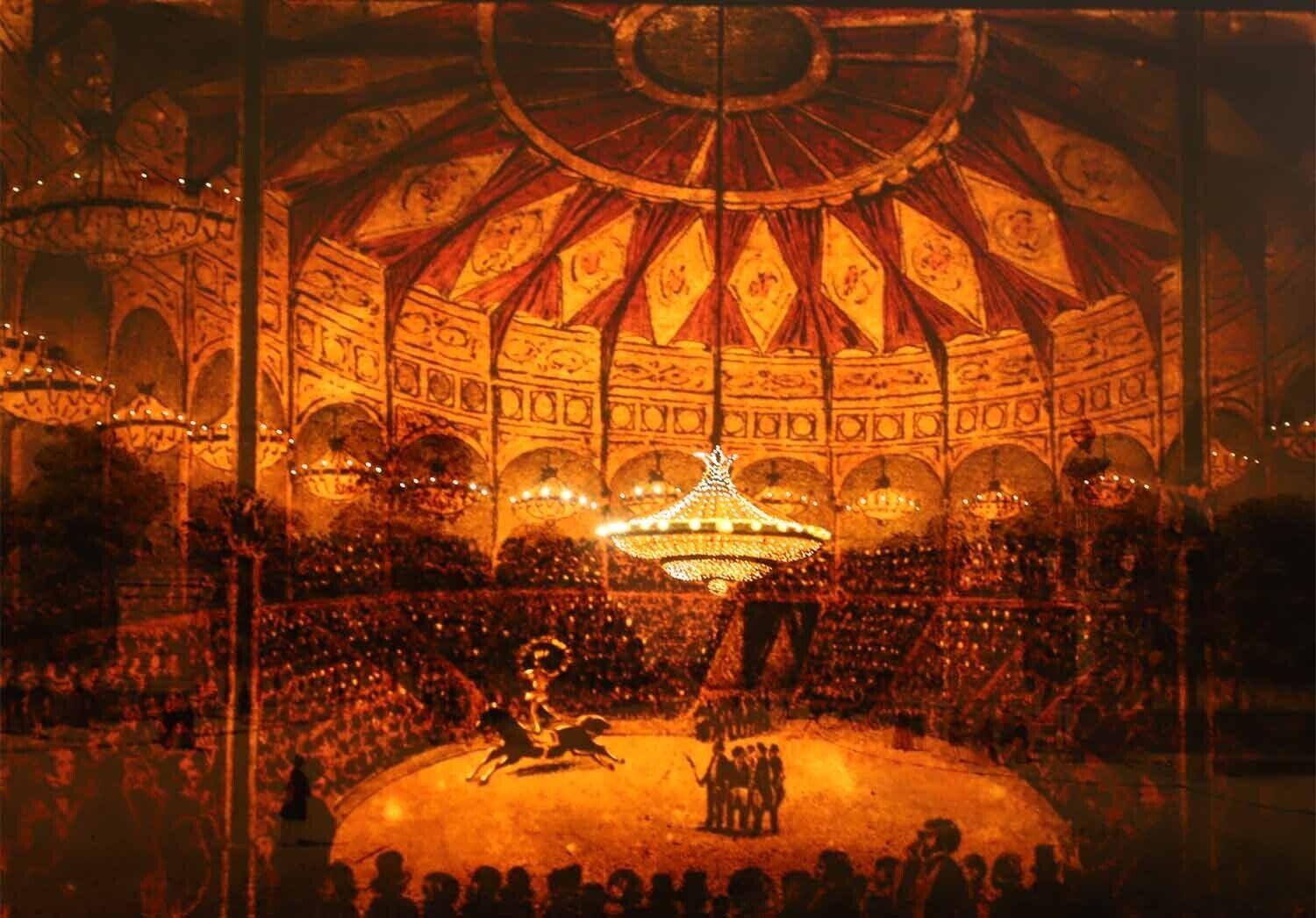
Polyorama Panoptique of the Circus and Champs Elysées, circa 1850, courtesy of F. Binetruy.
The European Circus History Conference, hopefully the first of a series held around Europe, will be a friendly and affordable event created by and for circus history enthusiasts and academics. Following an introductory day, the talks will take place over the weekend.
Friday 28 February 2025:
Daytime: Astley’s and Royal Circus walking tour, Early Circus Exhibition at Lambeth Archives (and maybe a visit to Westminster Archives)
Late afternoon/early evening: Tour of the National Centre for Circus Arts, Discussion and Drinks Reception
Saturday 1 and Sunday 2 March 2025:
Daytime: Conference Talks at The Cinema Museum, London, SE11
Saturday Evening: Maybe see Cirque du Soleil at the Royal Albert Hall
The volunteer-organised and not-for-profit conference is supported by the Circus Friends Association of Great Britain, National Centre for Circus Arts, National Fairground and Circus Archive, Lambeth and Westminster Archives, and by its venue, the Cinema Museum. The organising committee is Charlie Holland (ENG), Erik Åberg (SWE), Pauliina Räsänen (FIN), Harm van der Laan (NL), and Raffaele de Ritis (IT), whose biographies are below.
London is an appropriate place for an inaugural conference being the location of the original circus, Astley’s Amphitheatre, and of Dibdin’s and Hughes’ Royal Circus from which the form got its name. The talks and discussion will take place at Lambeth’s atmospheric Cinema Museum which is within walking distance of the sites of both circuses.
The ambition is to have a biennial conference, hosted in a different European country to the preceding one, and we welcome proposals for 2027.We hope this first conference will result in a small surplus to assist the subsequent one. It will also help fund conservation treatment of a couple of Astley posters at Lambeth Archives.
Tickets, likely to cost £50 / €60 inclusive of teas/coffees, will go on sale in September.
We are now inviting proposals of talksrelating to The Early Evolution of European Circus and its Disciplines, c1760s – 1860s.
Philip Astley opened his riding school in Waterloo in 1768, shortly afterwards moving to the foot of Westminster Bridge, the site of his Amphitheatre. This year’s conference focuses on developments in circus and its disciplines from around 1760 to the 1860s. Appropriately for a European event, the conference concerns circuses and performers active within any part of Europe, and also those who travelled into and from Europe.
We welcome proposals of twenty-minute or six-minute talks. Shorter talks (optionally in PechaKucha – Wikipedia style) might introduce one performer or a particular innovation, while longer talks will tend to take a broader view. There will be additional times for questions and answers.
Please submit the talk you really want to give. For inspiration, topics could include: competition and collaboration with pleasure gardens, hippodromes and the music hall; Astley’s early competitors; innovation and trends within circus disciplines, apparatus and choreography; the types of music in the circus and how music was used; the role and significance of women in circus, not least Patty Astley; the rise and fall of hippodrama; permanent and temporary buildings; the introduction of the tenting circus; lighting the ring and the act; touring circuits for circuses and for individual performers; humour within the ring; changes in circus promotion.
There will also be panel sessions of about 40 minutes with three or four panel members. If you have a topic and a panel to suggest please let us know.
Depending on adequate ticket sales, it is expected that most speakers will be offered free admission, and that five travel bursaries of up to £150 will be available.
Please send proposals to info@circusconference.org by 31st August 2024 at the latest and we will select speakers the following week. Submissions should be up to 200 words with a CV of up to 100 words . There will be equipment for PowerPoint presentations (which we will require at the latest a week prior to the conference). Please state any other technical requirements you have.
There will also be a small exhibition on site – attendees are invited to propose items to bring to show – and a book and ephemera sales stall.
Total on-site attendance including those speaking will not exceed c100 to keep the conference manageable and convivial. The talks are unlikely to be streamed this year, though recordings for archive use will be made.
The Venue
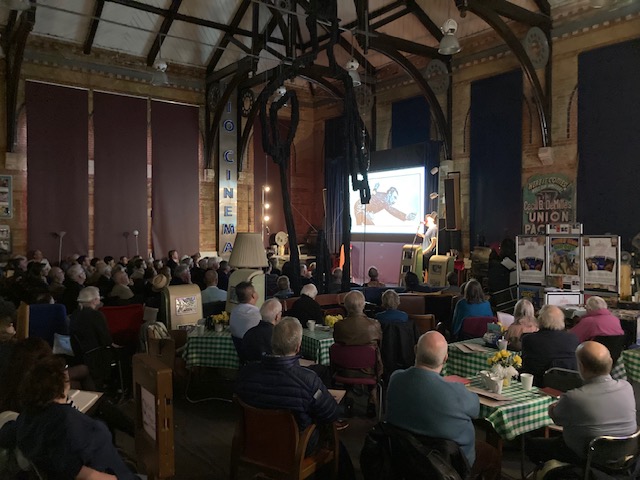
The conference takes place in Lambeth’s wonderfully atmospheric Cinema Museum, formerly a Victorian workhouse where Charlie Chaplin was briefly resident, in an area where many circus and music hall performers lived. The conference hall is on the first floor, up 20 steps (two flights of ten).
The Cinema Museum, Dugard Way off Renfrew Road, Lambeth, London, SE11 4TH.
A presentation at the Cinema Museum
The 2025 Conference committee:
Charlie Holland (UK), a former professional juggler who was instrumental in the development of The Circus Space, latterly National Centre for Circus Arts, as its Programme Director and Deputy Chief Executive. His books include ‘Strange Feats and Clever Turns’ on speciality acts in the 19th century. He is the Secretary of the British Music Hall Society and initiated and co-organised their first conference in 2023 and is co-organising their second in 2024.
Pauliina Räsänen (Finland), a circus and magic artist and cultural historian (MA) from Finland is a graduate of the renowned National Circus School of Montreal. Her performance background includes touring with Cirque du Soleil’s Alegria as a solo trapeze artist for six years. She is currently pursuing her PhD in Cultural History at the University of Turku, researching the forgotten history of women in circus and magic, and is CEO of ArtTeatro Ltd, a Finland based circus and magic arts production company
Erik Åberg (Sweden), an artist based in Stockholm who makes objects and performances, and has appeared in most European countries, Japan, Canada and the USA. He is.a PhD student in performative and media based practices at Stockholm University of the Arts where his research concerns circus, juggling, sculpture, history, archive and philosophy. An accomplished circus historian, Erik is the world’s foremost expert on the juggler Paul Cinquevalli, the subject of his newly published book ‘Cleverer than God’.
Harm van der Laan (The Netherlands), an artist and co-artistic director of both Tall Tales Company and the Tall Tales Studio, which has grown to become the main space for training and ongoing education of the professional circus community in The Netherlands. Harm teaches circus history at Codarts Rotterdam and is co-author of the book ‘Turning the cube: Perspectives on codes through juggling and visual arts’.
Raffaele de Ritis (Italy), writer and director, active in the USA and Europe, taking a modern theatrical approach to ancient spectacular traditions: circus, magic, cabaret. He wrote and directed for the world’s leading companies in the performing arts industry: Disney, Cirque du Soleil, Dragone, Ringling bros., Big Apple Circus, and Europe’s oldest theatres. His education crossed masters such as Federico Fellini and Dario Fo, art academies, century-old circus dynasties and the underworld of European variety. As a recognized historian in performing arts, he has authored seminal books and papers in seven languages, and teaches and lectures worldwide. Raffaele is custodian of an extensive private collection, and sits in the Performing Arts Council of Italy’s Ministry of Culture.

 European Circus History Conference